Painting · Thane and Palghar districts, Maharashtra, with parts of Gujarat and neighbouring territories
Warli painting
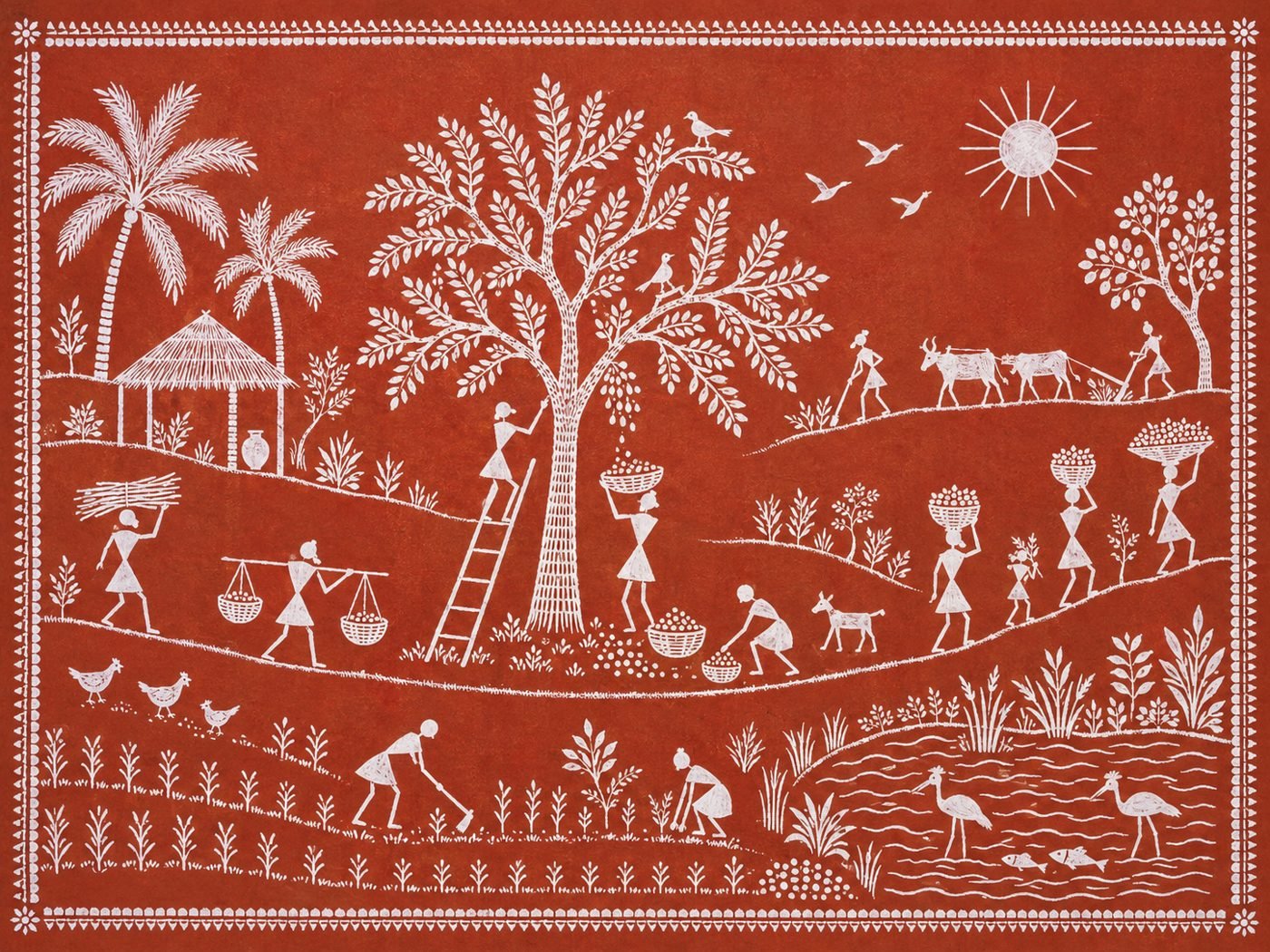
What is Warli painting?
Warli painting is a wall art of the Warli community, drawn in white on an earth-coloured ground. It builds people, animals and village scenes from simple geometric shapes. Sources disagree on its age, so no date is given here.
Who makes it, and where?
The Warli community, especially in Dahanu and Jawhar in Thane and Palghar districts of Maharashtra. A government tourism page also places the community in parts of Gujarat, Dadra and Nagar Haveli, and Daman and Diu.
How is it made?
Materials. A red earth mix and a cow-dung wash prepare the mud wall. Painting uses white rice-flour paste applied with a bamboo stick crushed at one end to form a brush. Paper, cloth and canvas are used today.
The sequence
- Coat the wall with red earth (lipane).
- Spread a cow-dung and water layer as the background (saravane).
- Paint with the bamboo brush using white rice paste (lihane).
- Compose scenes from lines, dots, triangles, circles and squares.
What do you see in it?
- White figures on a red-brown earth ground
- Triangles, circles and squares used to build bodies
- Lines and dots forming borders and rhythm
- Scenes of farming, animals, village life and customs
What does it mean?
Paintings were made on mud house walls for occasions such as harvests and weddings, and show the community's relationship with nature and daily life. Sources differ on deities: one government page mentions gods in scenes, another says the style avoids mythological figures.
How is it practised today?
Warli work now appears on paper, cloth, canvas, stationery and furniture sold through shops and galleries in Maharashtra. Commercial use has moved it well beyond its original setting of festival and wedding wall painting.
Protection. A government tourism page states Warli painting received Geographical Indication status in 2014, recognised as the community's intellectual heritage.
How can you learn from it with respect?
- Do not copy. Do not copy wedding or festival wall compositions as generic decoration, or present Warli-style figures as made by the community when they are not. Avoid sharing the name Warli for unrelated 'stick figure' patterns, and avoid specific named artists' works.
- Credit. Name the Warli community and region, and the artist where known, for example 'Warli painting by [name], Palghar district, Maharashtra'. State clearly if your work is only inspired by it.
- Support the makers. Buy from named Warli artists, cooperatives or government-registered artisans. A GI recognises the community's rights over the name, so use it only for work made by them.
- The principle you can learn. A small set of basic shapes can describe a whole world: limit your vocabulary, repeat it with care, and let rhythm and spacing carry the story.
Sources
- The enduring tribal artistry of Maharashtra: Warli paintings Incredible India, Ministry of Tourism, Government of India
- Tribes India GI products listing (PIB document) Press Information Bureau, Government of India