Floor drawing · Across India, with many regional names
Rangoli
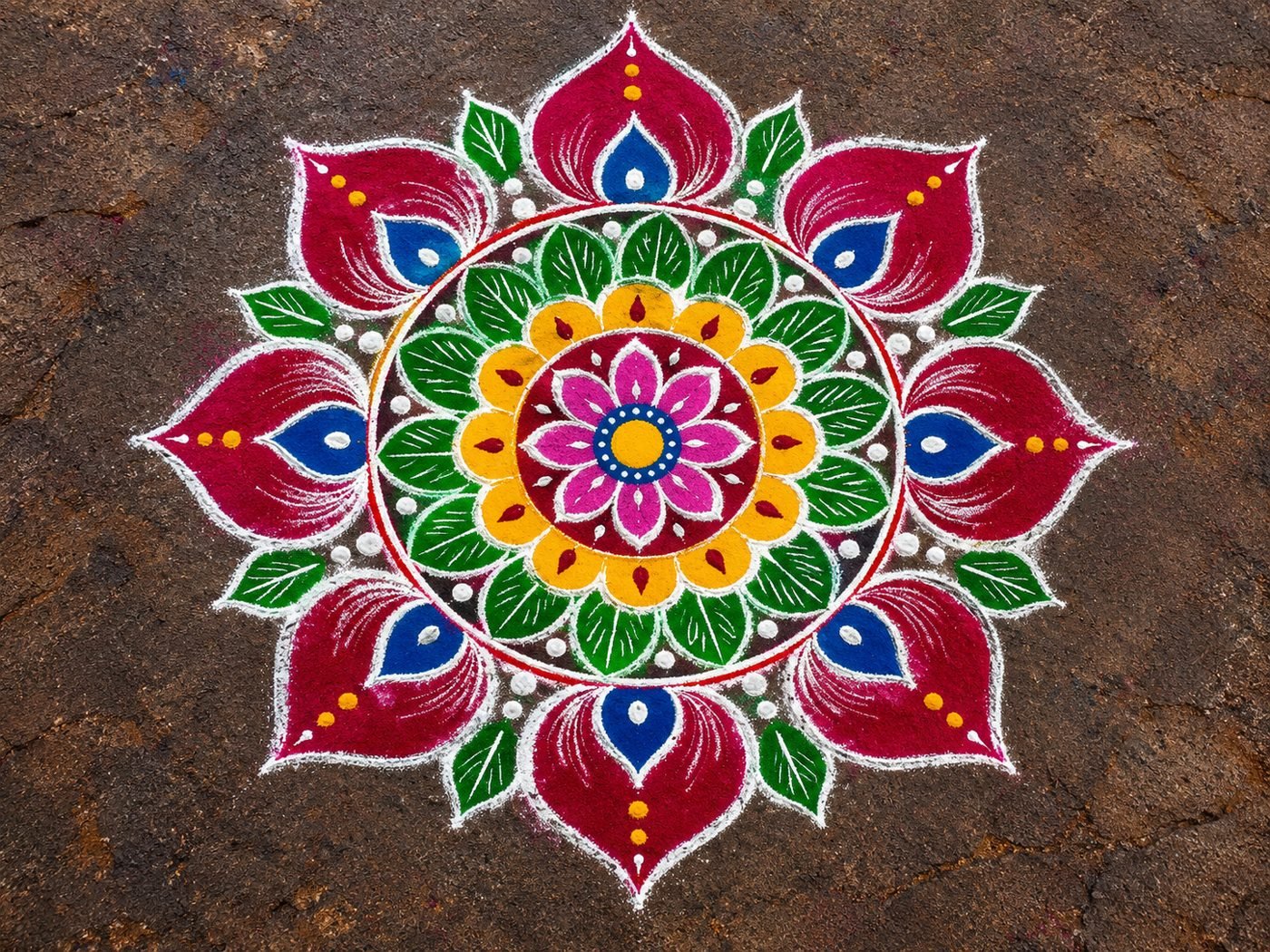
What is Rangoli?
Rangoli is a family of floor decorations made at entrances and sacred spaces, using rice flour, coloured powder, flowers or other materials. Some designs are geometric and dot-based, others are freehand or figurative. They are usually temporary and made for daily use or festivals.
Who makes it, and where?
Mostly women, though men make floor art in some rituals. Found across India; Britannica notes Sikh, Jain and Christian practice too. Regional names listed by sources include kolam (Tamil Nadu), muggu (Andhra Pradesh), alpana (Bengal), mandana (Rajasthan), aripana (Bihar) and satiya (Gujarat).
How is it made?
Materials. Rice paste or flour, dry colour powders, flowers, chalk, coloured sand, turmeric and vermilion. Floors may be cleaned or coated with cow dung or clay first. Stencils and sieves are used by some. Some now use paint to avoid redrawing.
The sequence
- Clean the floor, or coat it with clay or cow dung.
- Mark dots for the design, where a dot-based pattern is used.
- Join the dots with lines into petals, leaves or other forms.
- Fill the spaces with colour powder, working through shades.
- Outline with white rice or wheat powder.
What do you see in it?
- Dot grids joined into petals, hearts and leaves
- Circles, squares and triangles as base geometry
- Lotus, peacock, lamp and pot motifs
- Lakshmi's footprints at the entrance
- Border bands built around parallel lines
What does it mean?
Sources describe rangoli as welcoming guests and deities and bringing good fortune to the home. It marks daily morning ritual in the south and festivals such as Diwali, Pongal and Navratri, and life events such as weddings. Meanings differ by region and household.
How is it practised today?
Practice continues at homes and temples, with modern forms that include written greetings, paint, glitter and stickers. Designs differ by region, so one picture does not stand for all. Sources give no firm account of its age.
How can you learn from it with respect?
- Do not copy. Do not treat rangoli as one uniform style or label all floor drawing rangoli when regional practices have their own names and rules. Do not use ritual symbols such as footprints or religious signs as mere decoration.
- Credit. Use the regional name where you know it, such as kolam or alpana, and note the community, place and occasion.
- Support the makers. Learn from local practitioners, pay for workshops, and use sources that record the regional names and rules, so that rangoli does not erase them.
- The principle you can learn. Temporary work can still follow strict structure: base geometry first, then colour, then outline. Ephemeral does not mean careless.
Sources
- Rangoli Encyclopaedia Britannica
- Folk Art Practical, Lesson 5 (Rangoli) National Institute of Open Schooling, Government of India
- History of Rangoli, Teacher Resource Reading Museum