Textile · Punjab (India and Pakistan)
Phulkari
What is Phulkari?
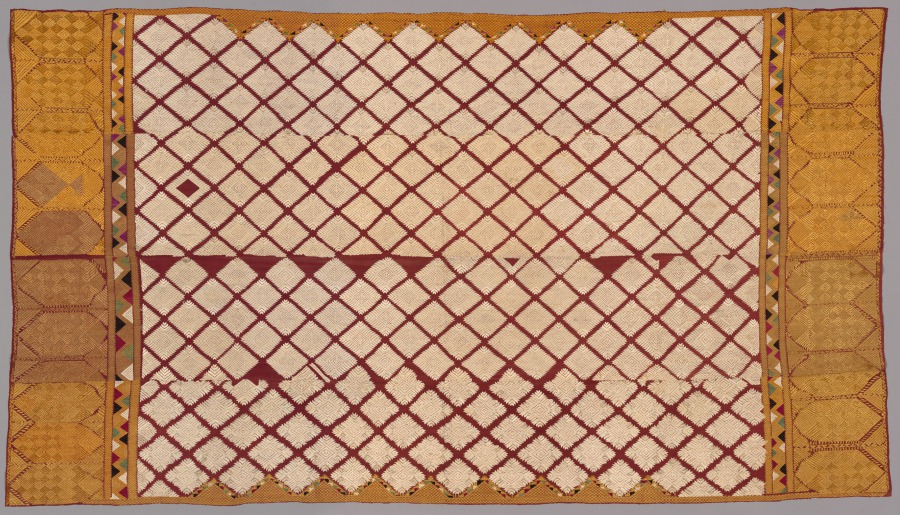
Phulkari is embroidery made by Punjabi women, worked mostly in darning stitch with silk floss on handspun cotton. The name refers to flower work. Cloths range from scattered motifs to bagh types where stitching covers the whole ground.
Who makes it, and where?
Museum sources describe Hindu and Sikh women in Punjab making phulkaris, passing skills through families, and girls beginning pieces for their dowries. The region is now split between India and Pakistan. A 2018 report counts about two lakh rural artisans in Indian Punjab.
Age. A museum shawl is dated 1875 to 1900; British records of the 1880s mention its ceremonial role
How is it made?
Materials. Handspun, handwoven cotton (khaddar) with counted threads, and silk floss called pat. Museum notes say floss came from China, Afghanistan and Bengal. Needle only; the base cloth guides stitch length.
The sequence
- Start with handspun, handwoven cotton cloth, often dyed.
- Count the cloth threads to guide stitch length.
- Work parallel straight darning stitches in rows along the weave.
- Change thread colour to build geometric shapes.
- In bagh types, continue until embroidery covers the whole cloth.
What do you see in it?
- Parallel darning stitches creating light-catching surface
- Geometric patterns drawn from the natural world
- Bagh types where the embroidery covers the whole cloth
- Named styles such as thirma (white ground) and sainchi (figurative)
- Red and shades of red, favoured as an auspicious base colour
What does it mean?
Museum sources link phulkari to a woman's dowry and to rituals around childbirth, death and marriage, and say the unbleached ground was seen as pure. A tourism page says it is worn at weddings and festivals. A RISD note says many ritual traditions largely ended after 1947.
How is it practised today?
Phulkari now appears on accessories, home decor and fashion garments. A 2018 newspaper report said machine-made imitations pass as handmade, middlemen take large shares, thread costs have risen, and the GI tag had not yet raised prices. That report may be out of date.
Protection. Registered Geographical Indication for embroidery (application 27, filed 14 March 2005, certificate dated 22 October 2010, valid to 13 March 2035). The registry lists the area as Punjab, Haryana and Rajasthan.
How can you learn from it with respect?
- Do not copy. Do not use machine embroidery or printed 'phulkari' patterns and call them hand made. Do not treat Indian and Pakistani Punjab histories as one, or reduce dowry and ritual cloths to generic ornament.
- Credit. Credit as phulkari, name Punjab (and India or Pakistan where known), and the maker or cooperative. State the type, such as bagh or thirma, if it applies.
- Support the makers. Buy or commission from identified women's groups and cooperatives, pay for the time hand stitching takes, and ask about GI authorisation. The 2018 report says artisans need direct market links and raw-material access.
- The principle you can learn. One simple stitch, laid in direction-changing blocks, makes light and pattern at once. Surface effect can come from the orientation of repeated marks, not extra shapes.
Sources
- Phulkari Philadelphia Museum of Art
- Thirma bagh phulkari 2011457 RISD Museum
- Phulkari Incredible India, Ministry of Tourism, Government of India
- Phulkari, GI application 27 Geographical Indications Registry, India
- For phulkari fullness The Tribune (newspaper, 2018, used for makers and challenges)