Technique · Kutch, Gujarat
Lippan kaam (mud-and-mirror work)
What is Lippan kaam (mud-and-mirror work)?
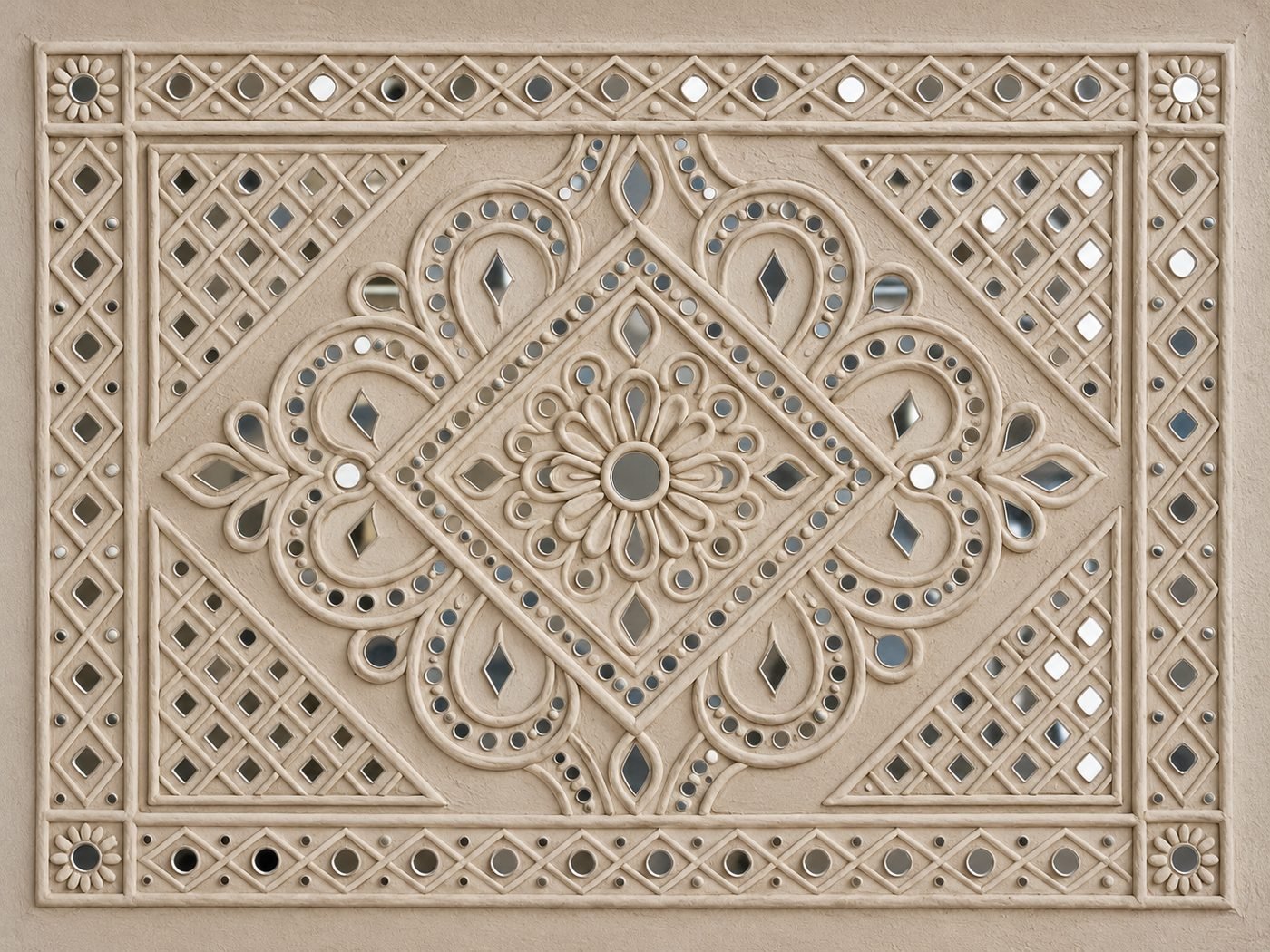
Lippan is relief work in clay with small mirrors set into it, traditionally applied to the walls of round village houses called bhungas in Kutch. Patterns are built up by hand and the mirrors catch lamplight. Today it also appears on panels and in urban interiors.
Who makes it, and where?
Described as practised by Rabari and Meghwal women, Mutwa and Kumbhar artisans, among others, in Kutch. One university paper says Hindu artisans use animals and plants alongside geometry, while Muslim artisans use only geometric forms. Accounts of who does what vary.
How is it made?
Materials. Local clay mixed with animal dung, sometimes with fibre or sand to limit shrinkage. Small mirrors or glass pieces, lime or natural pigments for white and colour. Mostly shaped by hand, without sketches in some accounts.
The sequence
- Mix clay with dung and fibre or sand into a workable mud.
- Plaster the wall surface with the mud.
- Build up relief patterns by hand, often freehand.
- Press small mirrors into the wet clay.
- Let the work dry, then add lime or pigment.
What do you see in it?
- Repeating geometric shapes in raised clay
- Suns and flowers in stylised form
- Peacocks, camels, and other animals among Hindu makers' work
- Small mirrors pressed slightly below the clay surface
- Patterns that echo embroidery and weaving
What does it mean?
It decorated homes and also served the building: sources say the clay insulates against heat and cold and the mirrors brighten dim rooms. One paper reports a belief that mirrors turn away harm. Sources note the origin of the art is not documented.
How is it practised today?
Makers are adapting it for exterior walls, panels and modern houses, and some pieces are waterproofed or made with glue and colour rather than clay. Sources describe artisans trying to keep it alive. Do not rely on unsourced age claims.
Protection. The Geographical Indications Registry lists 'Kutch Lippan (Mud Mirror) Craft of Gujarat' as a new application filed 31 December 2025 by Kutch Art Trust, Samtra. No registration is shown. One craft-association page claims a 2023 GI, which the registry page does not support.
How can you learn from it with respect?
- Do not copy. Do not copy a specific artisan's panel or a family's house patterns, or present resin or board imitations as traditional lippan. Do not suggest one community's motif set stands for all makers.
- Credit. Name it as lippan kaam from Kutch, give the community or artisan where known, and state if your work is an adaptation rather than made in clay.
- Support the makers. Commission work from named Kutch artisans, pay for design time as well as materials, and ask which communities and families the pattern belongs to.
- The principle you can learn. Material and climate shape ornament. Clay that insulates also holds relief, and mirrors add light where the room needs it.
Sources
- Indigenous Lippan Art Form of Kutch Region Chhatrapati Shahu Ji Maharaj University (Gyan Sanchay)
- Craft Name: Lippan Art All India Artisans and Craftworkers Welfare Association
- Kutch Lippan (Mud Mirror) Craft of Gujarat, GI application Geographical Indications Registry, Government of India
- Mud granary (kothi), Gandhi Nu Gam Google Arts and Culture
Open Lippan kaam (mud-and-mirror work) in the interactive guide