Floor drawing · Tamil Nadu and neighbouring South Indian states
Kolam
What is Kolam?
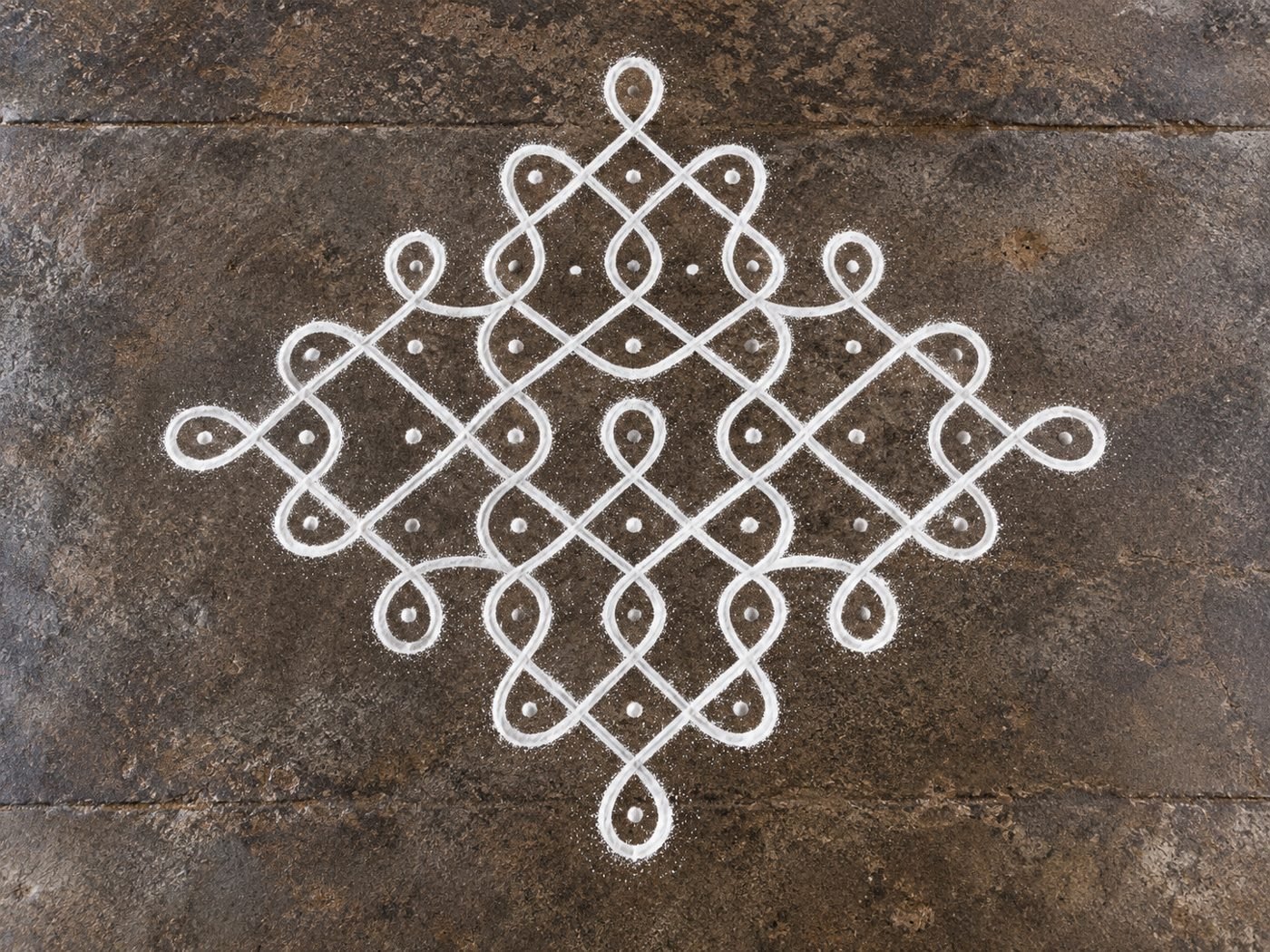
Kolam is a daily threshold drawing made on swept ground, usually with rice flour. Many designs are built on a grid of dots, with lines looping or joining around them. The drawing is washed away by use and weather and made again the next day.
Who makes it, and where?
Women across communities in Tamil Nadu, and also in parts of Andhra Pradesh, Karnataka and Kerala, usually learning from elders. Sources mention Tamil Hindu women mainly, and also Jain and Paravar Catholic women. Drawn at homes, temples and shops.
How is it made?
Materials. Rice flour or rice paste, dropped between thumb and fingers onto a swept, sprinkled floor. Coloured powders are used for festivals. Chalk or stone powder is often mixed in to cut cost. Wet rice paste gives longer-lasting designs.
The sequence
- Sweep the threshold and sprinkle water on it.
- Mark a grid of dots, called pulli.
- Release flour between thumb and finger to draw lines around the dots.
- In sikku kolam, loop one line around every dot and close it.
- Leave it to be erased by feet, wind and insects, then redraw.
What do you see in it?
- Pulli, the dot grid that organises the design
- Sikku, a continuous line looping around dots
- Symmetrical geometric patterns from repeated units
- Occasional birds, flowers and animals
- White rice-flour line, with colour added for festivals
What does it mean?
Sources describe kolam as welcoming guests and the goddess Lakshmi, as protecting the home from misfortune, and as feeding small creatures. One archive describes the interlaced lines as a maze that traps harmful spirits. Meanings vary by household and occasion.
How is it practised today?
Stencils, rollers and plastic stick-on versions are used, especially in apartments, and pattern books now include secular motifs. Daily hand drawing continues. Sources also note researchers study the mathematics of the designs.
How can you learn from it with respect?
- Do not copy. Do not present kolam as generic pattern art, strip it of its daily and ephemeral use, or pass off stencils as hand-drawn practice. Do not use it where its associations with welcome and mourning could mislead.
- Credit. Call it kolam, name Tamil Nadu or the specific region and community when known, and credit the woman or family whose pattern you draw from.
- Support the makers. Learn from practising women, pay for teaching, and document designs with their consent. Back cultural programmes that record practitioners' own explanations.
- The principle you can learn. A simple rule set, such as dots plus one closed line, can generate endless variety. Constraint drives design.
Sources
- Kolam: Ritualistic Threshold Drawings of Tamil Nadu, India Indira Gandhi National Centre for the Arts (ICH inventory)
- Significance of Kolam in Tamil Culture Sahapedia
- Kolam Tamil Nadu Tourism, Government of Tamil Nadu