Textile · Kutch and Saurashtra, Gujarat
Bandhani / Bandhej tie-resist dyeing
What is Bandhani / Bandhej tie-resist dyeing?
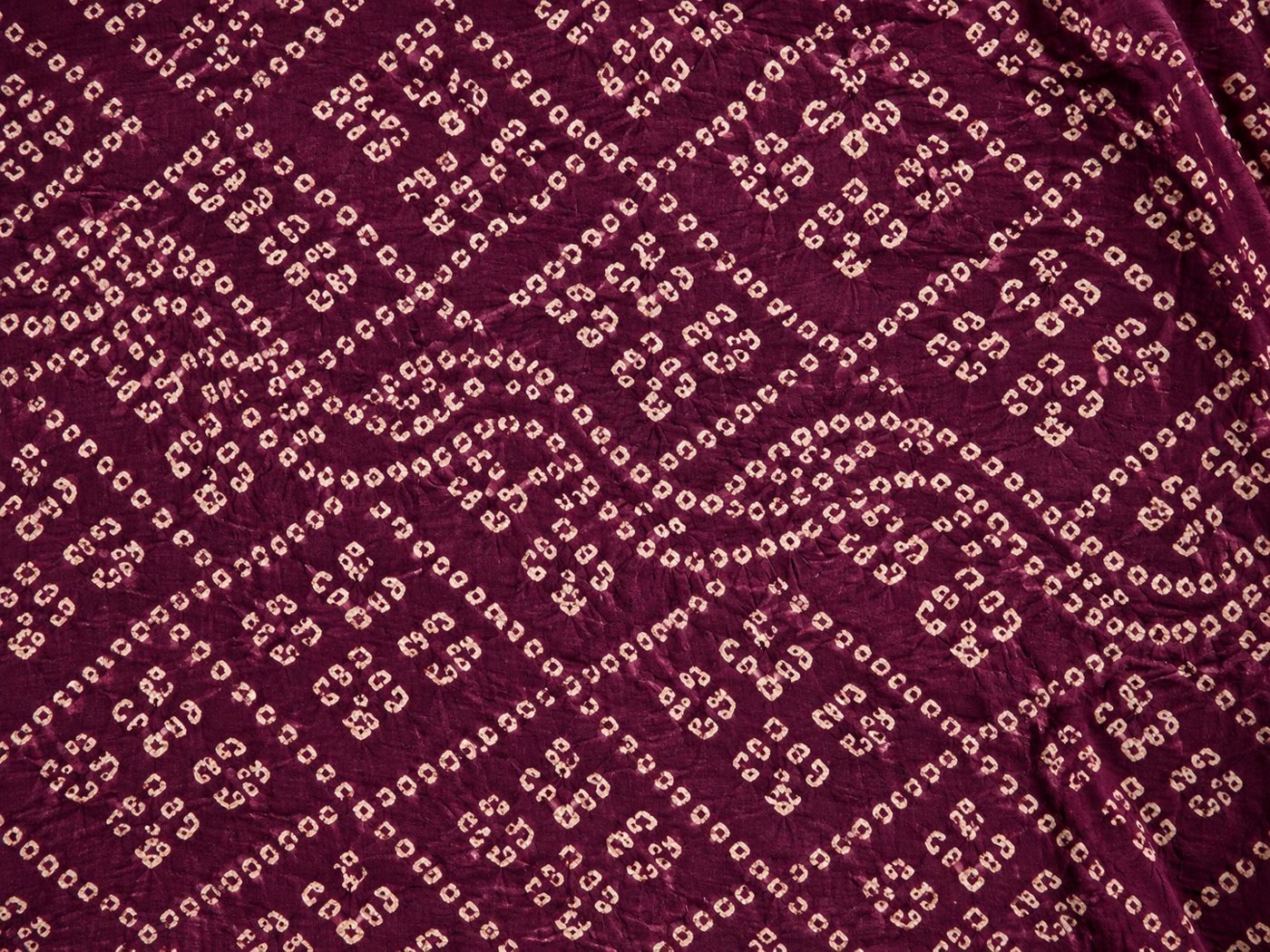
Bandhani is a resist technique in which small points of cloth are tied tight with thread before dyeing, so the tied spots stay pale. Patterns are made of many dots. The Gujarat GI document describes work in Kutch and Saurashtra.
Who makes it, and where?
A GI document describes Kutch work by the Muslim Khatri community, with women doing much of the tying, often at home. Wool veils are woven by the Vankar community. Jamnagar in Saurashtra is a main centre. The V&A notes variation within Khatri work.
Age. A V&A silk fragment from Gujarat is probably 15th century; older claims in a GI document rest on texts and paintings
How is it made?
Materials. Cotton, silk and wool cloth, thread, starch and geru for marking. Dyes were once plant-based, such as madder. Synthetic acid, vat and naphthol dyes are now common. Tying is done by hand, often on cloth folded in layers.
The sequence
- Bleach the cloth and mark the pattern with blocks or stencils.
- Tie each marked point tightly with thread.
- Dye in the lightest colour first, usually yellow.
- Tie more areas and dye again for each darker colour.
- Dry the cloth folded, then open the knots to reveal dots.
What do you see in it?
- Fields of tiny dots, with finer dots prized
- Dot groups called kadi and tribundi
- Laheria wave lines running from thin to thick
- Separately dyed borders and end pieces
- Pale tied spots against a dyed ground
What does it mean?
The GI document notes that ties are often left on until sale as a sign of authenticity. Sources do not give a single meaning for the patterns. A Gujarat silk fragment was found in a Jain manuscript, where silk was used to protect paintings.
How is it practised today?
Synthetic dyes are now common alongside older plant dyes. The GI document says a complete sari can take months to years of tying. Women artisans often work from home. The sources opened give no sales or export figures.
Protection. A copy of GI Journal 83 (31 May 2016) on a third-party site shows Jamnagari Bandhani, application 221, accepted for Saurashtra and Kachchh. I did not see the registration certificate. No GI for Kutch Bandhani as a separate item was confirmed.
How can you learn from it with respect?
- Do not copy. Do not call printed dot patterns or machine-made fabric bandhani. Do not call all tie-dye bandhani, or claim a hand-tied piece took days when it did not. Avoid passing off one regional style as all.
- Credit. Name it as Bandhani or Bandhej, give the region, such as Kutch or Jamnagar, and credit the community and workshop that tied, dyed or wove it.
- Support the makers. Pay for the long tying time, buy from tying and dyeing workers directly where possible, and ask for provenance, since the GI document says tying is largely home-based women's work.
- The principle you can learn. Resist methods turn restraint into pattern: what you leave untouched becomes the design, so plan the pale areas before the colour.
Sources
- Jamnagari Bandhani, GI application 221 (Journal 83 text) Geographical Indications Registry text, hosted on origin-gi.com
- Rumal (O72832) Victoria and Albert Museum
- Bandhani fragment (IS.40-1972, O70658) Victoria and Albert Museum
Open Bandhani / Bandhej tie-resist dyeing in the interactive guide