Textile · Kutch (Gujarat), Barmer (Rajasthan) and Sindh (Pakistan)
Ajrakh block printing
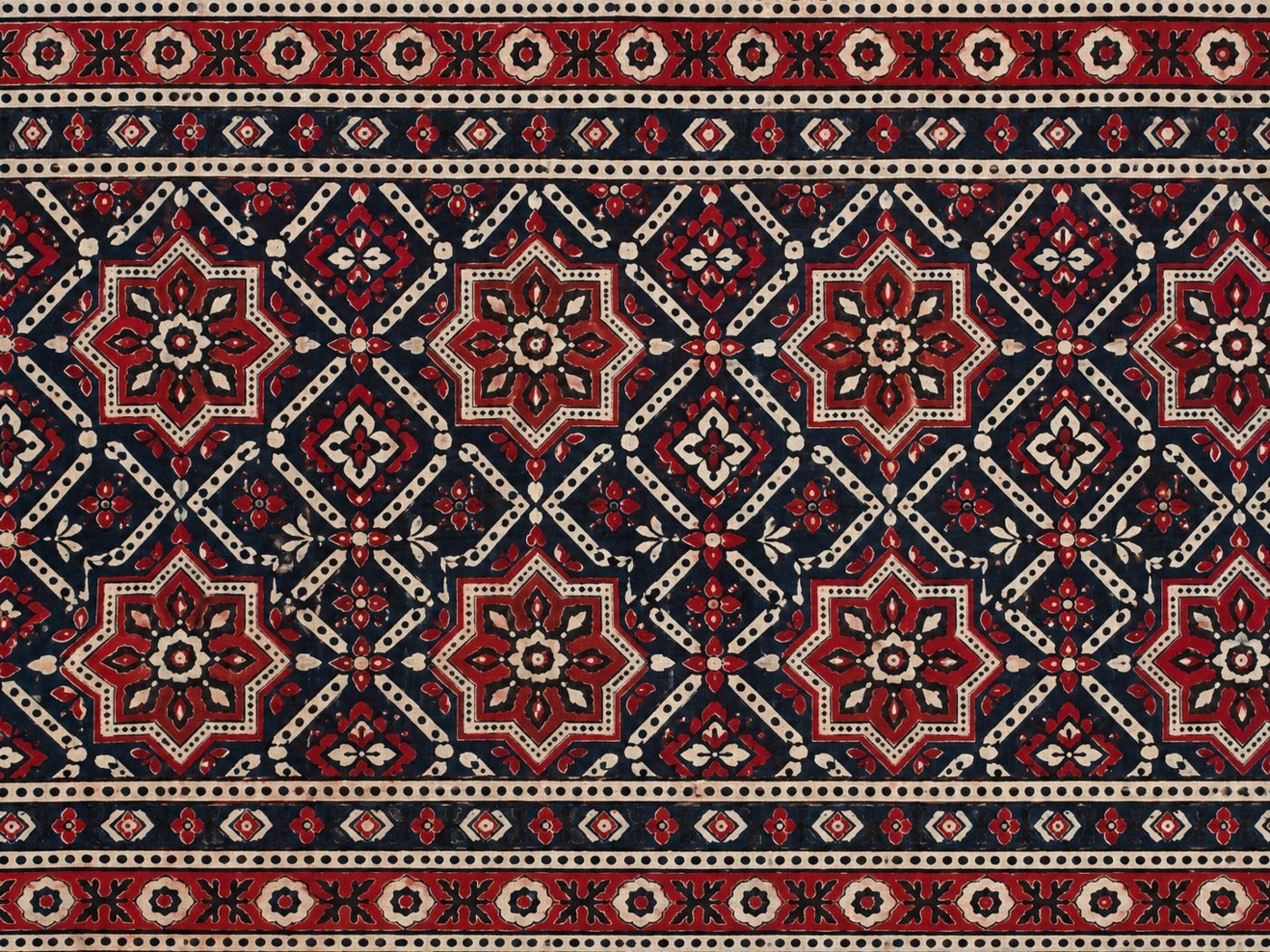
What is Ajrakh block printing?
Ajrakh is a cotton cloth printed by hand with wooden blocks and resist pastes, then dyed in several baths. It is traditionally blue and red, with black and white detail. It developed along the Indus region and is made today in Kutch and Sindh.
Who makes it, and where?
Khatri families are the hereditary printers. Sources say they moved from Sindh to Kutch, where Ajrakhpur is a main centre. Maldhari herders and Muslim Patels of Marwar traditionally wore it, and it also marks Sindhi identity. Practice differs between regions.
Age. Khatri printers are said to have come to Kutch about 500 years ago, and a source places the move in the 16th century
How is it made?
Materials. Cotton cloth, hand-carved wooden blocks and a printing table. Indigo, Indian madder and alizarin give colour. Myrobalan and alum are mordants. Gum arabic, lime, red clay and tamarind seed powder are resists. Sources vary on exact recipes.
The sequence
- Wash the cotton cloth and treat it with a myrobalan mordant.
- Print resist paste with wooden blocks.
- Dye the cloth in indigo and alizarin baths.
- Repeat printing and dyeing to build the layered pattern.
- Wash and dry in the sun to reveal the design.
What do you see in it?
- A large central field of repeated block prints
- Several borders and end panels
- Geometric symmetry, stars and flowers
- Motifs linked to Islamic architecture
- Matching patterns on both sides of the cloth
What does it mean?
Sources describe Ajrakh as everyday herder clothing for men, such as lungis and shawls, and as ceremonial dress for some communities. It has also become auspicious at Khatri weddings. It is described as a marker of Sindhi cultural identity.
How is it practised today?
Demand is strong at home and abroad, and makers have added saris, scarves and dupattas. Cheaper screen-printed versions have cut work for Maldhari customers. Makers report water strain in Ajrakhpur and a shift to synthetic indigo. A 2022 effluent treatment system was installed in Ajrakhpur.
Protection. The GI Registry lists 'Kutch Ajrakh' (application 1050, textiles) as Registered, filed 31 January 2023 by Ajarakhpur Hastkala Vikas Sangathan, Kutch. The registry page I opened left the certificate number and date blank.
How can you learn from it with respect?
- Do not copy. Do not sell screen-printed or digitally printed imitations as Ajrakh or hand-block work. Do not strip community or regional names, or flatten Sindh and Kutch styles into one look.
- Credit. Name it as Ajrakh from Kutch or Sindh and credit the Khatri workshop, family or village, such as Ajrakhpur, that made it.
- Support the makers. Buy directly from hereditary printers and workshops, ask about dyes and water use, and support effluent treatment and fair pay, which sources identify as pressures on the craft.
- The principle you can learn. Layering one colour step at a time, with each stage planned in advance, lets a limited palette produce depth and a design that reads from both sides.
Sources
- Kutch Ajrakh Development Commissioner (Handicrafts), Ministry of Textiles, Government of India
- Geographical Indication application 1050, Kutch Ajrakh Geographical Indications Registry, Government of India
- Ajrakh: Rhythm of Blues Crafts Museum, Delhi, via Google Arts & Culture
- Indigo in Kutch, India: Art and Science, Environment and Economics Mingei International Museum